

What if your wallet could tell you, before you click “confirm,” whether a transaction will silently drain tokens, overpay fees, or interact with a contract that has a history of exploits? That question reframes how experienced DeFi users allocate attention and capital. Rabby’s browser extension is built around that exact mechanism—pre-transaction simulation and risk scanning—and the result is a different set of trade-offs compared with mainstream EVM wallets.
This article dissects how the Rabby Chrome extension works, why its safety-first features matter to advanced US-based DeFi users, where the design still limits you, and how to think about choosing between Rabby and alternatives such as MetaMask, Trust Wallet, or Coinbase Wallet. I focus on mechanisms and operational consequences so you can decide whether Rabby meaningfully reduces your operational risk or simply changes how you manage it.
Core mechanism: simulation, scanning, and actionable output
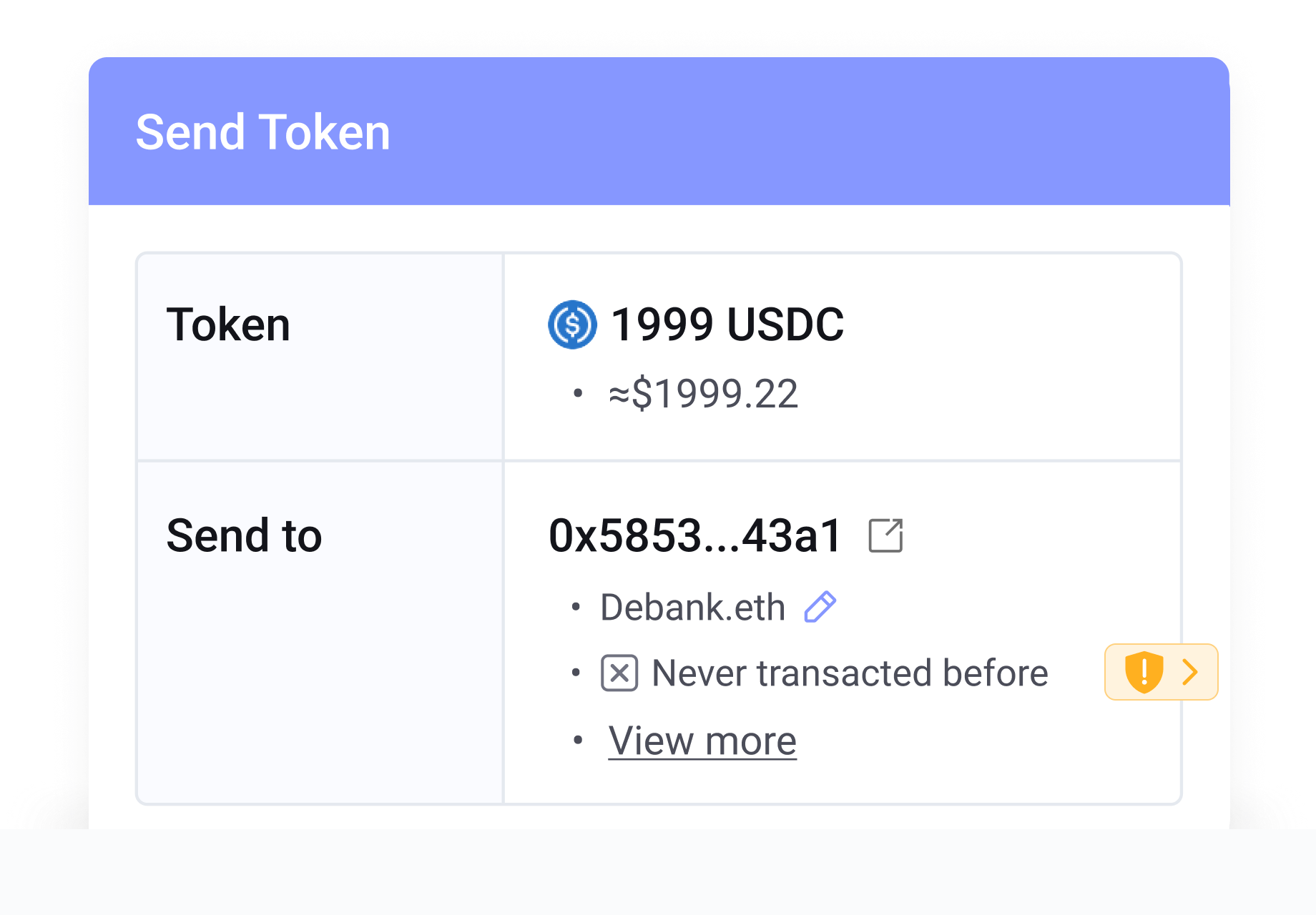
At its simplest, Rabby’s extension intercepts the transaction payload a dApp sends for signing and runs a local simulation that predicts token balance changes and gas costs before the user signs. This is different from a signature preview that only shows raw calldata: Rabby attempts to translate calldata into estimated net movements of assets and then displays them. It also runs the payload through a risk engine that flags things like approvals to unknown contracts, known exploited addresses, or suspicious recipient fields.
Mechanistically, simulation reduces the “blind signing” problem by replacing an opaque hex string with an expected outcome. That matters because many phishing or malicious flows rely on users approving a contract that superficially looks legitimate. When you see “you will lose X tokens to contract Y” instead of calldata, it changes the cognitive load: the decision moves from interpreting code to confirming a quantified outcome. That conversion is where Rabby’s value accrues for power users who interact with many unfamiliar contracts.
How the extension fits into a multi-chain DeFi workflow
Rabby is designed as a non-custodial multi-chain wallet with support for 90+ EVM-compatible networks including Ethereum, Arbitrum, Optimism, Polygon, BNB Chain, and Avalanche. For power users who arbitrage, provide liquidity, or test strategies across chains, two mechanisms stand out: automatic network switching and cross-chain gas top-up.
Automatic network switching reduces clicks and network-mismatch errors. If a dApp on Arbitrum requires you be on Arbitrum, Rabby will switch your active network for that session automatically—avoiding the common mistake of signing transactions on the wrong chain. The cross-chain gas top-up is a pragmatic utility: if your target chain has zero native gas token, Rabby helps you send the required gas from another chain, removing a coordination manual step that frequently blocks cross-chain flows.
Security architecture, limits, and historical context
Rabby is open-source (MIT) and supports a wide set of hardware wallets (Ledger, Trezor, Keystone, etc.), and enterprise integrations (Gnosis Safe, Fireblocks, Amber). Those elements signal a design intended for both solo power users and institutional custody flows. Open-source code allows third-party audits and community review, which is an important trust mechanism in the absence of third-party insurance or fiat custodianship.
But openness and features are not a panacea. Rabby’s own history includes a 2022 exploit associated with Rabby Swap, where roughly $190k was lost. The team’s response—freezing the contract, compensating users, and tightening audits—is an evidence point that the project can respond, not proof that exploits are impossible. This incident highlights a structural truth for browser-extension wallets: the attack surface is broad (smart contracts, UI overlays, extension permissions, and user error), and no single preventive feature eliminates that risk.
Trade-offs versus alternatives: MetaMask, Trust Wallet, Coinbase Wallet
Comparing wallets requires parsing which risks you want to reduce and which conveniences you prioritize.
– MetaMask: The de facto standard with broad dApp compatibility and large ecosystem mindshare. MetaMask’s advantage is reach and plugins, but it does not natively simulate transactions in the same way; users therefore rely on careful review or third-party tools. If you prioritize maximum compatibility and community support, MetaMask may win. If you prioritize preventing blind signing by default, Rabby’s simulation is the stronger safety tool.
– Trust Wallet: Mobile-first, custodial-on-boarding conveniences and embedded fiat rails (via partners). Trust Wallet is better when you need quick mobile access or fiat on-ramps, but it lacks Rabby’s pre-sign simulations and automatic network switching in the browser context.
– Coinbase Wallet: Integrates with a well-known exchange and provides easy fiat paths and compliance-friendly UX. For US-based users who prioritize regulated on-ramps and exchange-linked custody options, Coinbase Wallet reduces fiat friction. However, for advanced DeFi interactions that require simulative risk checks, Rabby offers clearer transaction-level protection.
In short: Rabby sacrifices an embedded fiat on-ramp and native staking utilities (current limitations) in exchange for a stronger transaction-security posture and convenience features for multi-chain DeFi workflows. That trade-off suits users who already move capital between chains and prefer external fiat solutions or exchange-linked custody for onboarding.
Operational heuristics for power users
Here are decision-useful rules you can adopt if you use Rabby as a primary extension wallet:
1. Treat simulations as a strong signal, not an oracle. Simulations are model-based and can miss subtle contract state changes or off-chain oracle updates. If a simulated outcome looks implausible, pause and inspect the contract; don’t assume the simulation is infallible.
2. Combine Rabby’s approval revocation with hardware wallets for high-value holdings. Use the native revocation tool to clear excessive token approvals and keep large balances behind a hardware device or a multi-sig (Gnosis Safe) for large exposures.
3. Use automatic network switching deliberately. Automatic switching reduces errors, but confirm the destination network in the UI for cross-chain trades—attackers sometimes craft interfaces that visually mimic legitimate networks.
Practical limitations and what Rabby does not solve
Important boundary conditions: Rabby does not provide a fiat on-ramp in-wallet, and it lacks native staking functions as of the described feature set. Those omissions matter depending on your workflow. If your priority is direct debit-card buys inside a wallet, Rabby forces you to route through exchanges or third-party on-ramps. If you expect in-wallet staking dashboards or liquid staking integrations, you will need separate tools.
Additionally, security features like simulation and scanning reduce human-error surface area but do not prevent every exploit vector. Smart contract vulnerabilities, supply-side attacks on dApps, or targeted social-engineering aimed at stealing seed phrases remain outside the protective envelope of pre-transaction checks. The 2022 exploit shows that even projects with active security tooling can experience losses; mitigation therefore requires layered defenses: hardware wallets, multi-sig for significant pools, approval hygiene, and conservative exposure limits.
Where Rabby likely moves the needle—and where to watch next
For users who interact frequently with new dApps or who sign many approvals, Rabby’s simulation and approval-management tools directly reduce exposure to blind-signing attacks and approval-based drains. The combination of automatic network switching and cross-chain gas top-up also materially reduces operational friction for cross-chain DeFi strategies—a non-trivial efficiency gain for active US-based traders or liquidity providers.
Signals to monitor that would change the value proposition: broader on-ramp partnerships (reducing the fiat friction), deeper native staking integrations, or evidence of systemic security regressions. Conversely, further integrations with institutional custody providers (Gnosis Safe, Fireblocks, Amber) will increase Rabby’s attractiveness to teams and DAOs that need programmatic multi-sig workflows.
FAQ
How does Rabby prevent “blind signing” compared to other wallets?
Rabby runs a local simulation of the transaction to predict token flows and gas costs, then displays the estimated net changes. That turns raw calldata into an outcome-focused summary. Most alternatives show calldata or human-readable labels without an explicit simulated balance change, so Rabby reduces one common source of confusion that attackers exploit.
Can Rabby replace my hardware wallet or multi-sig setup?
No—Rabby complements hardware wallets and multi-sig solutions. It integrates with Ledger, Trezor, Keystone, and multi-sig providers like Gnosis Safe and Fireblocks. For high-value holdings or institutional flows, a hardware device or multi-signature policy remains best practice.
Does Rabby work with the dApps and chains I use in the US?
Rabby supports 90+ EVM-compatible chains and is available as a Chromium extension (Chrome, Brave, Edge), mobile app, and desktop client. It is compatible with the majority of mainstream dApps that operate on EVM chains, but always test unfamiliar integrations in small-value transactions first.
Where can I download or learn more about the extension?
For an overview and links to installers and documentation, see this page for the rabby wallet.
Bottom line: Rabby’s Chrome extension is an operational shift, not a magic bullet. For DeFi power users in the US, it meaningfully lowers the cognitive friction and most common blind-signing risks behind frequent cross-chain activity. But it does not remove the need for layered security—hardware wallets, multi-sig custody, conservative approval policies, and continuous vigilance remain essential. Use Rabby to tighten the decision surface; don’t let it replace basic safety hygiene.
